Chandan Yatra and Chariot Construction Ceremony
ARTICLE
Prof. Sarbeswar Kar
11/5/20236 min read
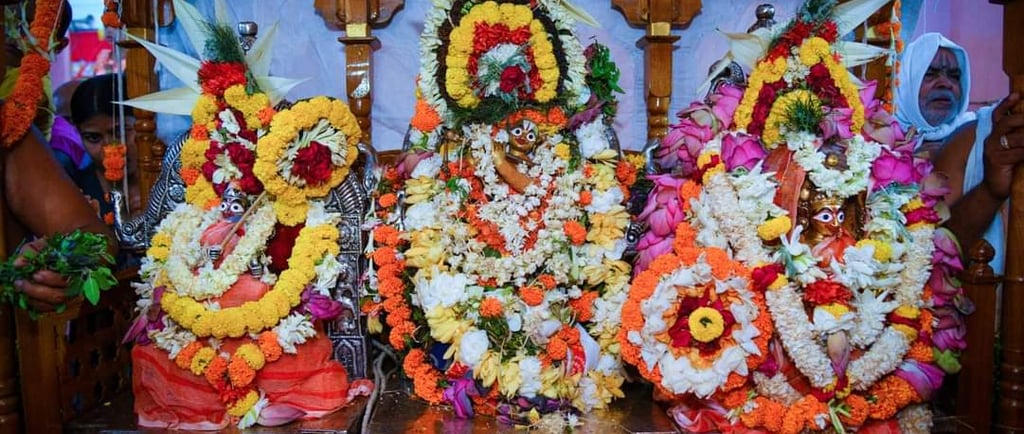

The 21 day long Chandan Yatra of Lord Jagannath is observed on the day of Akshay Trutiya at holy town Puri. The Yatra is held at Narendra Pushkarini in accordance with the religious rituals. The idols of Madanmohan, Bhudevi. Sridevi, Ramakrushna and Panchu Panday take part in the Chapat or water sports. Lord Jagannath follows a schedule for the Chapa Khela or water sport in the Narendra Pushkarini every year. According to the practice, after performance of the mid-day puja. Lord Jagannath would move for the water sports. As a mark of the beginning of Chandan Yatra on the auspicious day of Akshay Trutiya. Nitis like Mangal Alati, Mailam, Abakash, Rosha Homa. Surya Puja, Dwarpal Puja, Gopal Ballabh and Sakal Dhup are performed and the deities board the bimans or vessels at around 12 o'clock and make for the holy pond Narendra Puskarini. On the other hand, the construction of chariots for the deities begins on that day after receipt of Agyanmala for the same. After the fixing of the time for Nitikanti. Servitors and Shrotriya Brahmins perform rituals on a 12-feet Dhaura wooden log, marking the beginning of the Rath Yatra. The Chandan Yatra which is also. known as Gandhalepana Yatra of deities of Sri Jagannath temple is performed for 42 days at the pilgrim town of Puri. The Yatra is observed in two parts: Bahara Chandana and Bhitara. Chandana. Bahara Chandana starts from Akshaya Tritiya and continues for 21 days. On the first 21 days the representative idols of the main deities of the Jagannath temple as well as five Shivalingas known as the Pancha Pandavas are taken in a procession from the Singhadwara or the Lion Gate of the Jagannath temple at Puri to the Narendra Tirtha. After various rituals the deities are placed on grandly decorated boats for an evening cruise of the tank. The last 21 days include rituals held inside the temple itself. Instead of the daily cruises, the playful ride happens on four occasions, the Amavasya, the full moon night, on the Shasthi and the Ekadashi of the bright fort night. The deities go out of the temple to enjoy boating in the Narendra tank for 21 days. As per the religious practice in the Jagannath temple. Madan Mohan, the representative image of Lord Jagannath accompanied by five Shivalingas go to Narendra tank. a huge water body in the heart of the city for a cool bath to beat the scorching summer heat. As per the schedule. Madan Mohan, His consort Laxmi accompanied by five Shivalingas believed to be incarnation of Panch Pandavas begin their pleasure trip from the temple in six separate palanquins along the Grand Road (Bada Danda) to Narendra tank situated about 1.5 km away from the temple for sandalwood paste bath and boating. With the deities on board the decorated palanquins are carried over the shoulders of a special set of servitors known as Biman Badu. The temple musicians recite notes ofGeeta Gobinda and Odishi Bhajans. The youths of various Jaaga Chars (schools of martial arts) accompany the deities displaying their skills along the Bada Danda. The rhythmic body movements of palanquin hearers in concert with swinging of the top half of the decorated palanquin, particularly of Madan Mohan called "Manivimana" is a rare treat for the pilgrims and devotees. The accompanying devotees in the procession participate in the bathing ritual and join in grand feast which follows the bathing. The playing of Odissi Dekha Go Radhamadhaba Chali' (Please see the walking style of Radha and Madhab) on clarinets accompanied by trumpets, cymbals and blowing of conch shells besides display of fireball skill (banati) in the procession present a splendid scene along the Bada Danda. The deities on their arrival at the Narendra tank are accorded sandal wood paste and aromatic water bath for cooling effect. Then the deities are taken in procession to their respective boats shaped as giant swans. The deities on board move about the tank enjoy the notes and dances of Odissi presented by danseuses on the decks till late in the evening and return to the temple in the same manner and style which were followed at the beginning of their journey time. This scene is repeated everyday and on completion of twenty one days the concluding ceremony known as 'Bhaunri' is observed with display of fireworks and music extravaganza. On the other hand, construction of three chariots for forthcoming Rath Yatra also begin. Shrotriya Brahmins headed by the temple priest perform a Yajna with Nrusingha Mantra in the chariot construction yard (Rath Khala) to consecrate the timber logs to be used for construction of three chariots. Earlier on the Ram Navami day the wood logs selected for use in construction are purified by observance of Homa. Amidst singing ofkirtans and bhajans (devotional songs), sounds of cymbals and gongs. the idols of Lord Madanmohan accompanied by Devi Bhudevi and Devi Sridevi in one palanquin and idols of Lord Ramkrushna and Pandavas in another palanquin are taken in a procession from Shree Mandir to the Narendra pond in the afternoon. En route to the Narendra pond, the procession stops in front of Shree Nahara (the Puri king's palace) on the Grand Road where priests of Shree Mandir along with the Shrotiya Brahmins complete all the rituals at the chariot construction yard Following the completion of Puja. agnyanmalas (onder in the shape of garlands from the Lords to commence chariot building for Rath Yatra) are placed on a 12-feet dhaura log marking the beginning of chariot construction for Rath Yatra. The procession later reaches the Narendra pond where the idols board two newly built Chapas or boats-Nanda and Bhadra- which are rowed then for a long time by the Sevakas. Temple dancers dance and sing on the boat during the rowing. The construction of the chariots starts on Akshaya Tritiya, the third day of the bright fortnight of Vaisakha, with ritual fire worship. This takes place in front of the palace of the King of Puri and opposite the main office of the Puri temple. On this day, the new agricultural season starts and farmers start ploughing their fields. This day marks the beginning of the summer festival of the deities. known as the sandalwood festival or Chandan Yatra. In this festival. the representative images of the presiding deities are taken out in colourful processions and given a ceremonial boat ride in the Narendra tank everyday. In an interesting demonstration of the assimilative character of the Jagannatha cult, Madanmohana and Rama Krushna, representing Jagannatha and Balaram partake in the festival with the representatives images of the presiding deities of five main Shiva temples of Puri. These are curiously known as Pancha Pandava, the five brothers of the Mahabharata story. Later the deities have a ritual bath in a small temple in the middle of the tank, in stone tubs filled with water, sandalwood paste, scents and flowers. This sandalwood festival culminates in the Snana Yatra, the Bathing Festival on the full moon day of the month of Jyestha. On this day. the presiding deities descend from their seats on an elevated platform in the sanctum sanctorum, the bejewelled throne. They are bathed in 108 pots of water brought from the suna kua, the golden well and assume the elephant form on the special bathing platform, close to the Eastern boundary wall of the temple. From that day the deities remain in symbolic and ritual convalescence for about two weeks. They are barred from view of the ordinary devotees. Only three special patta chitras, traditional Odia paintings of natural colours on cloth stiffened with starch, known as Anasara Pattis, are strung on a bamboo screen hiding the deities from public view, can be seen by the public. During this period, the deities are given only roots, leaves, berries and fruits to cure them from their indisposition. This ritual is a reminder of the strong tribal elements in the genesis and evolution of the Jagannatha cult. The progeny of Lalita, daughter of the original tribal worshipper Biswabasu, chieftain of hunters, and the Brahmin priest Vidyapati, are known as Daitapatis or Daitas. They have almost exclusive privilege of serving the Lord during the convalescence and through the entire period of Ratha Jatra or the Festival of Chariots. People from different places come to Puri to witness the Chandan Yatra festival of the Trinity.
The socio-cultural activities of Odias are reflected in Jagannath cult. Like human beings Lord Jagannath gets up early in the morning from bed, performs daily activities, takes break-fast, launch and rests a while during mid-day, goes to bed at night. These activities are performed through rituals and offerings at different points of time during the day. Similarly the deities in Puri temple feel scorching hit during the Summer as the humans do and to get rid of the Summer pain, they go out of the people on a pleasure trip to a grand pond called Narendra Puskarini for water sports. They, after being smeared with sandal paste in order to get the cooling touch, play in the pond which is known as Chandan festival. This festival begins on Akshay Trutiya day and ends on Snana Purnima day spanning for a period of 42 days every year.
Don't miss out on exclusive news related to Shree Jagannath Culture
Subscribe to our Newsletter
Postal Registration No.- PURI/45/2022-24
CBC Code No.- 320402
Copyright ©2023 . Shree Shrikhetra Soochana Newspaper, All Rights Reserved.
Rajesh Kumar Mohanty
(Editor & Publisher)
Shree Shrikshetra Soochana Newspaper
Raghunath Bhavan, Narendra Kona
Puri, 752001, Odisha, India
Contact
RNI Registration No.- ODIBIL/2021/81452