Festivals in Shri Jagannath Temple
ARTICLE
Sarmistha Barik
7/19/20236 min read
Chandana yatra is celebrated for 42 days, divided into two phases/periods of 21 days each. The first phase is known as Bahara Chandana or outer Chandana. During this period, the representative images of Rama, Krushna, Madanamohana, Lakshmi and Biswadhatri and images of Lord Siva from the five Siva temples known as Panchu Pandaba are taken in a procession to the Narendra puskarini / Pokhari on their respective Bimanas (chariots carried on human shoulders). In the Narendra puskarini, the images play in two beautifully decorated and illuminated Chapas (boat-houses) and worshipped. They are generally taken around the Pokhari in these Chapas. Then they are carried to a house known as Chandana Ghara inside the tank, where they are bathed for some time in scented water. Thereafter, they are dressed and decorated and bhoga or food offerings are made. Finally. second round of cruise takes place with the said Chapas and then the images return to the main Temple. The last day of the first phase of the Chandana yatra is called Bhaunri. Thousands of people enjoy this festival with great delight. The second phase of 21 days known as Bhitara Chandana is celebrated inside the main Temple. Niladri Mahodaya: It is celebrated on the eighth day of the bright fortnight of Baisakha (AprilMay). It is stated that on that day Lord Jagannath was first worshipped in this Kshetra. On this occasion, 108 pots of consecrated water are offered to the deities. Thus, a special abhisek (bath) is performed for the deities. Nrusingha Janma Birthday of Lord Nrusingha is observed on Baisakha Sukla Chaturdasi i.e. the 14th day of the bright fortnight of Baisakha (April-May). The image of Lord Nrusingha is taken to the Jagannath Ballabha Matha, where special nitis are performed. Sitala Sashthi: Marriage of Lord Siva and Goddess Parbati is observed on Jyestha Sukla Sasthi i.e. the sixth day of bright fortnight of Jyeshtha (May-June). On this occasion, Goddess Lakshmi welcomes the newly married couple in her temple. Rajendrabhiseka: It is celebrated on Jyeshtha Sukla Dasami Le. the 10th day of the bright fortnight of Jyeshtha (May- June). Rukmini Harana Ekadasi: Marriage of Lord Krushna and Goddess Rukmini is celebrated on Jyeshtha Sukla Ekadasi ie, the 11th day of bright fortnight of Jyeshtha (May-June).
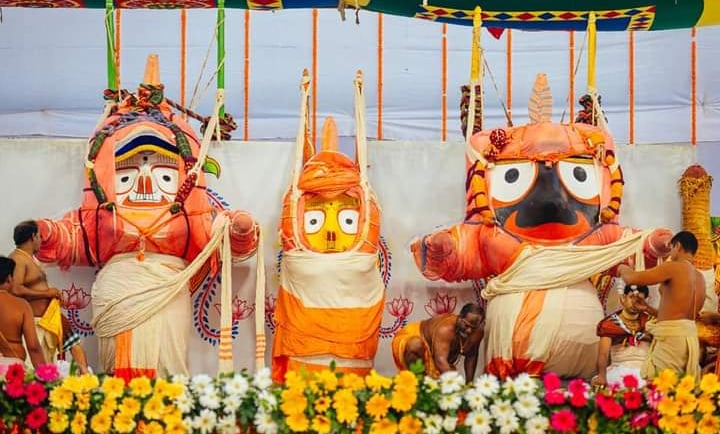
On this occasion, the marriage is held between Lord Madana Mohana as Lord Krushna and Goddess Lakshmi as Goddess Rukmini. Champaka Dwadasi: It is celebrated on Jyeshtha Sukla Dwadasi ie. the 12th day or on the next day of Rukmini Harana Ekadasi. Dehasnana Yatra: It is the bathing ceremony of the deities, celebrated on Jyeshtha Purnami i.e. on the full moon day in the month of Jyeshtha (May-June). The three deities alongwith Sudarsana and Madanamohana are brought out from the Garbhagruha (sanctum sanctorum) of the Temple and taken in a traditional procession called Pahandi and placed on the Snanabedi situated in the northeast corner of the Bahara Bedha (outer enclosure). This is the first occasion in the year when the large and heavy wooden images of the deities are brought out of the Garbhagruha to the Snanabedi. There, the deities are bathed with 108 pitchers of water from a well called Suna kuan (Golden well) near the uttara dwara (north gate). Water from this sacred well is used only once in a year during the Snana Yatra of the deities. The usual daily rituals continue thereafter in the Snanabedi. After the Snana Yatra, the deities are dressed like Lord Ganesha (the elephant god) who bears the head of an elephant. That is why this besha is also known as Hati Besha. At night, the deities return to the Temple in a procession and the deities, except Madanamohana, are placed in a place called Anasara pindi. They remain there unseen, secluded and unexposed to public view for a period of 15 days. During this period of seclusion, the sevakas of a particular group known as Daitapati perform certain Gupta (secret) nitis (rituals) of the deities. These rituals are called anasara nitis. On Pratipada tithi i.e. the day before the Ratha yatra, the deities give darsan to thousands of eager devotees. This darsan is known as Nabajaubana darsan. A special niti (rite) called Netrotchhaba takes place on this occasion. On this day onwards, the Ratha yatra period actually starts till the deities return back to the main temple after spending some days in the Sri Gundicha temple. Ratha Yatra (Car festival): This festival is held on Asadha Sukla Dwitiya i.e. the second day of bright fortnight of Asadha (June-July) every year. This festival is also known as Sri Gundicha yatra and Ghosha yatra. As per the prevailing tradition, Gundicha was the Rani (queen) of Raja Indradyumna, the legendary builder of the first temple. She had initiated this grand festival. Hence, this festival is known after her name. It is also said that Sri Gundicha temple was the place where Lord Jagannath had his first manifestation in the present form and thus, is the birthplace of Lord Jagannath. On this day, the deities are taken out from the Temple and placed in their respective rathas (chariots), kept near the Singha dwara.
The deities are carried to the rathas in a traditional ceremonial manner called Pahandi when Lord Balabhadra and Lord Jagannath are made to swing forward and backward. As per tradition, at first Sudarsana comes out followed by Lord Balabhadra, Goddess Subhadra and finally Lord Jagannath. The ratha of Lord Jagannath is called Nandighosha. It has 16 chakas (wheels) and the colours of the fabrics that cover the roofs of the ratha are red and yellow, The ratha of Lord Balabhadra is known as Taladhwaja, which has 14 chakas and the colours of the fabrics are red and green. Devi Subhadra's ratha Debadalana has 12 chakas and fabrics of red and black. In other words, the colours of the fabrics used to decorate the Rathas are yellow, green and black respectively. mixed with red. Logs of wood for the Rathas are procured from the forest of Dashapalla range, located about 200 kms away from Puri. Government of Orissa in Forest Department takes special care and efforts to provide required number and quantity of logs of wood with prescribed specifications for the purpose. The three Rathas are dismantled after the festival is over. As per the tradition Sudarsana sits by the side of Devi Subhadra in her ratha. Madanamohana, the representative deity of Jagannath Mahaprabhu sits in the ratha. Rama and Krushna take their seats in the ratha of Lord Balabhadra. These small idols are made of brass. Thus, seven deities namely Lord Jagannath, Lord Balabhara, Devi Subhadra, Sudarsana, Lord Madanamohana, Lord Rama and Lord Krushna are seated on three rathas. After the deities are seated on their respective Rathas, the Gajapati Maharaja of Puri sweeps the floor of the Rathas. This niti is popularly known as Chhera Pahanra, which is a great attraction of this festival. This signifies that even the highest sovereign power of the state is only a sevaka (servant) before the Almighty. After the Chhera Pahanta niti is over, the charioteers are seated on the respective chariots, the horses (four in each Ratha) are tied and the ropes (usually four in each Ratha) are fitted. A huge log is used as the break in each Ratha, which is operated manually. Thereafter, the general public are allowed to pull the Rathas irrespective of caste, creed, sect, and religion and sex distinctions. This liberty indicates that the deity is equal for every person on earth and grants equal opportunity to all. Also, the festival signifies that the deities desire to come down to the level of the common man for some time and move with them to Sri Gundicha Temple, which is at a distance of about three kms from the main temple. According to the tradition, first the ratha of Lord Balabhadra is dragged followed by those of Devi Subhadra and Lord Jagannath. It is a nine-days festival, when the deities are taken to the Sri Gundicha Temple from the main Temple along the Bada danda (Grand Road) in three gorgeously decorated Rathas, especially made for each of the three principal deities. Normally, the Rathas reach the destination by the evening on the very first day of the festival and on the ninth day of this festival, the deities are brought back from the Sri Gundicha Temple to the Singha dwara of the main temple on the same Rathas. Thus, the deities practically spend seven days in the Sri Gundicha temple. The return journey is known as Bahuda yatra and is observed in the same manner as Ratha yatra.
It is said that there are twelve important yatras (festivals) of Jagannath Mahaprabhu celebrated in the Shri Jagannath Temple, Puri. But actually there are many more yatras observed in the Shri Jagannath Temple, Puri throughout. the year. Some important festivals celebrated in the Temple are described below in brief: Maha Bishuba Sankranti: The Sankranti of the month of Mesa ie. Baisakha (April-May) is called Maha Bishuba Sankranti or Pana Sankranti. The birthday of Lord Hanumana is observed on this day in the Temple. It is worth mentioning that Oriya calendar starts from this day. Akshya Trutiya & Chandana Yatra: The Chandana Yatra starts from Akshya Trutiya i.e. the third day of the bright fortnight of Baisakha (April-May).
Don't miss out on exclusive news related to Shree Jagannath Culture
Subscribe to our Newsletter
Postal Registration No.- PURI/45/2022-24
CBC Code No.- 320402
Copyright ©2023 . Shree Shrikhetra Soochana Newspaper, All Rights Reserved.
Rajesh Kumar Mohanty
(Editor & Publisher)
Shree Shrikshetra Soochana Newspaper
Raghunath Bhavan, Narendra Kona
Puri, 752001, Odisha, India
Contact
RNI Registration No.- ODIBIL/2021/81452