Glory of Lord Shree Jagannath
ARTICLE
Dr. Bhaskar Mishra
5/4/20238 min read
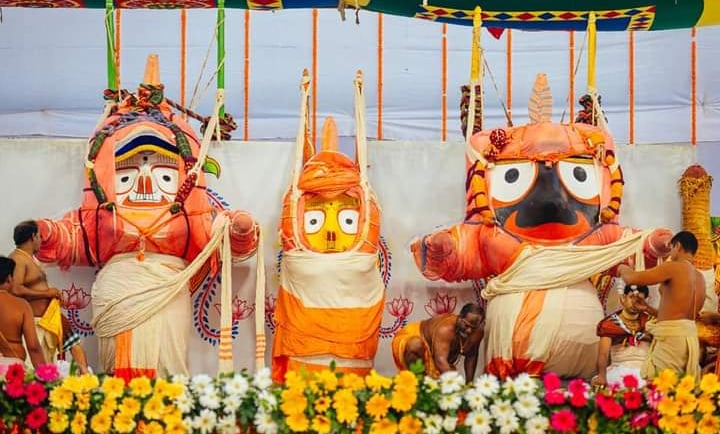
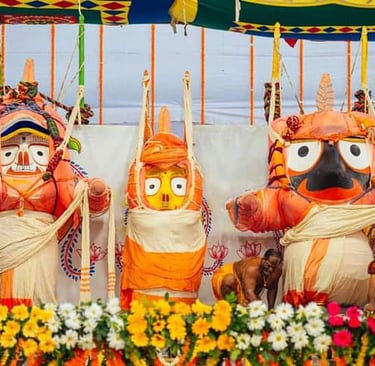
Anoted scholar Dr. Mayadhar Mansingh has aptly said that, "Jagannatha is the God of the people among all Hindus gods and goddesses. Among all the deities of this subcontinent Lord Shree Jagannatha has evolved out of the spiritual inspirations of the ordinary mass. The word Jagannatha literary means the Lord of the Universe. He is the symbol of universal love and brotherhood. Skandapurana, the most voluminious of the eighteen Maha Puranas mentions the sanctity and glory of this most ancient and sacred Kshetra in the flowing words (Chapter-1 and sloka 8-9) "Although Lord Shree Jagannatha is all prevading and is the source of all, and there are also other holy places which destroy all sins, yet this holy place is superior as it has became the body of this supreme Being. He Himself is present three assuming a form and has indeed made that place known by His own name. Several other puranas, particularly BrahmaPurana, Padmapurana and Agnipurana, also contain namations about the manifestation of Lord Shree Jagannatha in Purusottama Kshetra in more or less the same manner as Skandapurana. Apart from the puranic literature, other historical evidence regarding worship of lord Shree Jagannatha in Pari is found only from the eighth centrury onwards. It is interesting to note that another book "The Aquarian Gospel of Jesus the Christ" published in the year 1907 by a Christian pastor of America. named Levi H.Dowling specifically mentions that young Jesus travelled to India and Puri upon the invitation of a prince of Odisha who had gone to Jerusalem and Nazareth. Dowling further writes that Jesus was accepted as a pupil in the Temple of Jagannatha; and here learned the vedas and other sastras (manic laws). If the above finding regarding Jesus visit to India and Puri are accepted as authentic and correct then the antiquity of the tradition of Lord Shree Jagannatha will date back in to the pre-christian era. The ancient temple of Lord Shree Jagannatha at Puri, ever since its inception has been an institution of unique importance in which millions of Hindu devotees have reposed their faith as the epitome of their tradition and culture. Puri, the abode of the Lord Shree Jagannatha is an important place of pilgrimage in India because of its religious sanctity and rich cultural heritage. It is one of the most sacred shrines of India. According to historian Ananta Burman Chodaganga Dev of Ganga dynasty who had constructed the present temple known as Shreemandir or Jagannath Temple reigned from 1078A.D. to 1147 A.D. Because of the able administration of Chodaganga Dev for a long period of 70 years political stability as well as religious tolerance could be maintained. According to the temple architectural text (silpa shastra) the temple (Shreemandira) in the shape of five chariots belongs to rekha category. From a copper plate namely (Nagari copper plate) inscription it is known that king Ananga Bhim Dev-III conducted the consecration ceremony of the present edifice in the year 1230A.D. As per the Puri District Gazetteer, "Among the existing temples in Odisha, the temple of Jagannatha is the hightest. Shree Jagannath Temple at Pari having 214 feet 8 inches height is a famous temple throughout eastern India. Similarly as per the settlement document, Shree Mandira or Shree Jagannath Temple has been recorded in the name of Managing Committee of Shree Jagannath Temple. The area of the said temple is 10 acres 734 decimals. There are two huge concentric boundaries known as the Inner as well as outer bedha of Shree Mandir. The temple is surround by four gates such as Singha dwara (Lions gate). Dakhina dwara (South gate), Paschima dwara Western gate) and Uttara dwara Nrothern gate) on the east, south, west and north side respectively of the temple.
As per Utkal style of construction, this temple has been divided into four parts such as Garbha Griha(Sanctum Sanctorum), Jagamohana (audience hall). Natamandap (dancing hall) and Bhoga Mandapa (Refectory hall). The height of Jagamohana is 120 feet. The height of Natamandapa and Bhogamandapa is 30 feet and 50 feet respectively. Hundreds subsidiary temples, Ananda Bazar, Kitchen, two gardens, seven wells, some Mandapas and the holy banyan tree(Kalpabata) are there inside the temple premises.
The sanctum sanctorum is a square type structure having both 30feet length and breadth. The height of the sanctum sanctorum is 48 feet. The Ratna Simhasana is located inside the sanctum sanctorum (Garbhagriha) of the temple. As per the Temple Records of Rights one rectangular wooden structure known as Kanakamundi has been fixed on the pillars of Rantasimhasana. One multi coloured applique called as "Chandua" is tied with Kankamundi, i.e. over the deities. The Ratna simhasana is situtated over plot No.1 as mentioned in the ROR of Shree Jagannath Temple. It has been constructed with black granite. The height, length and breadth of the Ratna Simhasana is 4 feet. 16 feet and 13 feet respectively. The said Ratnasimhasana or bejewelled flat form faces towards the east. The round shaped black granite blocks are kept on the Ratnasimhasana. The wooden images (daru) of four principal deities have also been installed on the Ratnasimhasana. Besides the four principal wooden images of Shreedevi and Bhudevi are found in the company of Chaturdhamurti on the Rantasimhasana. So these deities are called as "saptadha Vigraha. "During the rituals and festivals, majestic Beshas (costumes) of the principal deities on the Ratnasimhasana are performed. The daily ritual of the deities is based on the manual of worship. These daily rituals are accepted as 'Niti. Since ancient time, the different methods of worship prevalent in different sects have been reflected in the rituals of Shree Jagannatha, as a result, the same have become lively and humane. According to noted scholar and educationist Dr. Satyabadi Mishra, "He is a living God, who lives and moves with us. He is so much humun, so much divine." Everyday hundreds of priests or servitors are engaged for performing sebapuja to the deities. The conglomerate rites, rituals and festive occasions of the temple are unique and not compareable with any other temple in India. The spiritual consciousness linked with Lord Shree Jagannatha is by itself a supreme consciousness of the mankind. Shree Gundicha yatra or Chariot festival of Shree Jagannatha is considered one of world's largest religious festivals which is being celebrated since time immemorial. Similarly Nabakalebara festival is an integral part of Jagannatha consciousness. The word Nabakalebara means new body. This term has actually been derived from sanskrit language. This ceremony usually takes place once in 8 to 19 years depending on the Hindu almanac. The principal wooden deities change their bodies on the eve of the intercalary Asadha Month. Nabalalebara Ratha Yatra is one of the country's most incredible spectacles as well as one of the most popular festivals. The affairs of Shree Jagannath Temple at Puri were looked after with great devotion and care by the successive Hindu ruling dynasties of Odisha for whom Shree Jagannath Mahaprabhu had come to be regarded as the State deity. The famous Ganga monarch Chodaganga Dev, after constructing the present edifice in the 12th century A.D. conferred the old endowments of Shree Jagannath made new endowments and laid the foundation of a sound administration for managing the affairs of the temple. During the reign of Ananga Bhima Dev performance of different rituals. provision of Servitors and above all the management of the temple could be done in an effective and systematic way. Since then the temple was managed smoothly be independent Hindu kings till 1568. The temple administration in the subsequent period remained under the control of Afghan (1568-1588A.D.), Muslims (1588. 1751A.D.), Marhatta (1751-1803 A.D.) and British East India company (1803-1947). During the reign of Moghul, king Mansingh had given the responsibility of the kingdom to Ramachandra Dev (1), the king of Khurdha in 1590. Muslims and Marahatta rulers were managing the temple with the help of Hindu Officers. For various reasons mismangement was seen in the rituals and functioning of the temple in the post-independent India as a result of which State Government formulated "Puri Shri Jagannath temple (Administration) Act, 1952." As per this Act, a Record of Rights indicating the duties and responsibilities of various servitors with reference to the rites, rituals, festivals etc. was prepared. One Special Officer in the rank of a District Judge was appointed for this purpose. He submitted his report on 15th March, 1954. Accordingly, an Act was formulated in the year 1954. The "Shri Jagannath Temple Act, 1955" came in to force in 1960. It is to be indicated here that the Hon'ble Supreme Court of India pronounced a historic judgement on 15th March, 1964 Vide Civil appeal case No. 135/1962. "The temple occupies a unique position in the State of Orissa and is a temple of national importance and no other temple in the State can compare with it. It stands in a class by itself and considering the fact that it attracts pilgrims from all over India in large numbers it must be a subject of special consideration by the State Government. There after Government took over the administrator of temple and appointed a Senior Officer or State Government as Administrat of the temple. As per section 6 of Shree Jagannath Temple Act. 1955, the king of Puri was declared as hereditary Chairman of the Managing Committee of the Shree Jagannath Temple. Section 5 of the Act states that "the administration and the governance of the Temple and its endowments shall vest in a committee called Shri Jagannath Temple Managing Committee constituted as such by the State Government. It shall be a body corporate. After the introduction of Shri Jagannath Temple Amending Act, 2004, the Managing Committee as well as administrative structure are upgraded with effect from Feb,2005, Accordingly an IAS Officer in the rank of Revenue Divisional Commissioner has been appointed as the Chief Administrator of the Temple in place of Administrator. Similarly the Committee constituted by the said Act consists of 18 members. The responsibility of repair, maintenance and conservation of the temple has been entrusted to the Archaeological Survey of India since 1979 by an agremeement. Presently the annual budget of temple is more than 100 crores. As the management of such a large institution is highly important many high ranking Officers of State Government have been appointed to ensure its smooth management. The temple administration is now under the direct administrative control of Law Department, Government of Odisha To facilitate comfortable stay of the devotees coming from different places to holy city Puri, the temple administration has built four numbers of residential clusters known as Bhaktanivas located at Grand Road, Jail Road and near Shree Gundicha Temple, Puri. Recently the State Government have taken up a big project namely "Shreemandira Parikrama Prakalpa" around the Shree Jagannath Temple for beautification and smooth movement of the devotees.
Puri, the seat of Lord Shree Jagannatha, otherwise known as the Purusottama Kshetra or Shreekshetra is an important centre of Hindu piligrimage in India. Like Badrinath, Kedarnath, Amarnath, Rameswara and Tirupati, it is a large sanctuary which is the destination of all piligrims in the Sub-continent and it has been accepted as an all South Asian Shrine by James J. Preston. From the early (at least from the Gupta Age) till the present time Jagannatha Puri became a full grown Kshetra for the Hindus with considerable political social support. The cultural tradition of Odisha has been enriched due to Shree Jagannath consciousness. It is not possible to discuss the history, art, culture, sculpture and literature of Odisha ignoring Lord Shree Jangannath Out of the four hallowed shrines located at four cardinal points of the Indian subcontinent, Shree Jagannath Dham Puri is believed to be the spot which the Lord chooses to dine at on a wide variety of foods. The Lord venerated here as the Devadhideva means Lord of Lord's and Rajadhiraj (King of kings) reclines on the sumptuous divans of the Ratna Vedi or Bejewelled throne and guzzles about a sixty kind of delicacies during the course of a single day.
Don't miss out on exclusive news related to Shree Jagannath Culture
Subscribe to our Newsletter
Postal Registration No.- PURI/45/2022-24
CBC Code No.- 320402
Copyright ©2023 . Shree Shrikhetra Soochana Newspaper, All Rights Reserved.
Rajesh Kumar Mohanty
(Editor & Publisher)
Shree Shrikshetra Soochana Newspaper
Raghunath Bhavan, Narendra Kona
Puri, 752001, Odisha, India
Contact
RNI Registration No.- ODIBIL/2021/81452