
Goddess Bimala at Puri
ARTICLE
Professor of English, Utkal University, Vani Vihar, Bhubaneswar 751004.
10/10/20248 min read
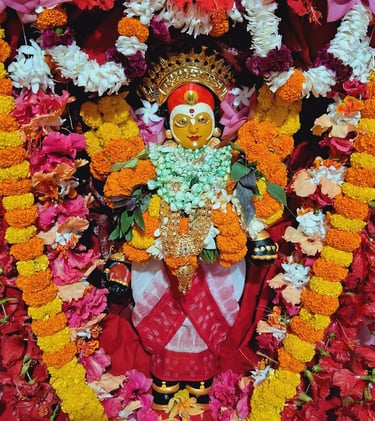
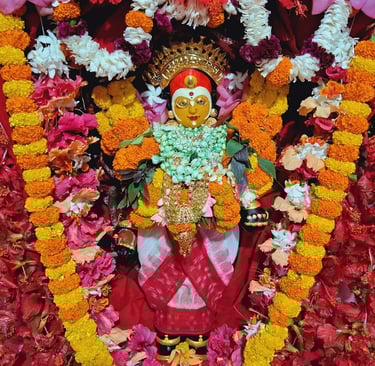
The title of this article is the translation of a famous line in Sanskrit from an important scripture, Bimala Purusottame which means that Bimala stays at Purusottama or Puri. This supposes that the proper name Bimala used to be a very familiar name of Goddess Durga during the time when the scripture was written. It also means that the name stood for the supreme importance of the deity. Another line in Sanskrit states thatBimala is a great goddess and Jagannath is an awesome appearance of Lord Shiva : Bimala tu Mahadevi Jagannathastu Bhairava. That Bimala is a great goddess being an appearance of Durga goes without saying. But to say that Jagannath or Vishnu is an appearance of the awesome aspect of Shiva and for that matter Bimala is his consort needs explanation. The question raised is how Vishnu can be Shiva. But the answer is not difficult to find. The three primordial principles of creation, preservation and destruction representing the Hindu deities of Brahma, Vishnu and Shiva are not mutually exclusive, but inclusive. They are not watertight compartments, but are continuous and all-embracing wholes. In other words, Vishnu is not different from Shiva. So Ramakrishna Pramahansa once declared that Jagannath is only Shiva and his idol is only a Shivalinga and should be worshipped as such. Similarly, one can say that Bimala is Laxmi, the consort of Vishnu, because both are parts of the same mother principle. It is because of this reason again that Puri is regarded as a meeting point and melting pot for the worships of both Vishnu and Shiva, of Durga, Laxmi and Saraswati, an idea which finds extensive elaboration in scriptures. The Brahma Puran in particular speaks of the sameness of Vishnu and Shiva in its account of sage Markandeya. So let us come back to our basic argument. Bimala is a great goddess whose worship at Puri is of supreme importance for the Hindus. Out of the fifty-two +places sacred to the worshippers of the mother principle, the very first one is Puri where the feet of Goddess Sati, an incarnation of Durga fell on earth when Vishnu chopped her body off with His wheel in order to pacify Shiva, who was angry due to his first consort Sati's untimely death. In this story we see a philosophy, a synthesis between principles and a comprehensiveness and the allembracing nature of Hinduism. It also speaks of the oneness of godhead in a diversity. So Bimala's presence at Puri not only makes this sacred place the first of the holy spots for the worshippers of the mother principle, it also preaches comprehensiveness, the basic tenet of a great religion. The last but not the least question is why Sati's feet should fall at Puri and not at any other place on earth. In answer one may say that this is the postulate of a scripture which cannot and should not be questioned. You may either accept or not accept it. Bimala's temple is situated at the right hand western corner of the tower of Jagannath, just by the side of the Rohini Kunda. The temple's closeness to the Rohini Kunda is a testimony to its ancientness, because Rohini Kunda is one of the two most ancient relics existing in the precinct, the other being the holy banian tree named Kalpavata. The Bimala temple is similar in structure and height to the Nrusimha temple near Muktimandap which, according to historians, was built in the ninth century. As one enters the Bimala temple one sees the idol of a majestic lion, Durga's animal vehicle riding an elephant which signifies the victory of good over the mighty evil. The great Salabeg, a Muslim poet of the seventeenth century, sings the glory of the spot in one of his beautiful songs on Jagannath written in Oriya language. The entrance to the sanctum sanctorum is decorated with figures of Shaivite and Shakta deities. The various appearances of Goddess Durga as well as paintings depicting the goddess's role in subduing the demons attract the devotee's attention most. The inner temple houses the principal idol of the goddess which is said to be a sixth century structure because it is bereft of elaborate decorations. The goddess possesses not too comely and not too angry a face and wields two arms holding a pitcher said to contain nectar in one hand and a rosary in the other. That she does not wield weapons is an evidence of the benevolent nature of the goddess. She is, therefore, a goddess of goodness, of godly traits of long life and devotion. So she is in the most peaceful appearance of Goddess Durga. No separate food items are usually cooked for the goddess for ritual offering. But the cooked food offered to Jagannath in various rituals becomes mahaprasad or the famed Jagannath rice only after being specially offered to Bimala. So after the puja of Jagannath a little of his offering is given to Bimala in a ritual. Bimala is described, therefore, in scriptures as a goddess who lives on the remnants of Jagannath's food. There is a legend in the background of this practice. Once Shiva, a god of the Hindu trinity, went to Vaikuntha in order to meet Vishnu. But the latter had just taken his food, a few grains of which had fallen on the ground. Shiva picked up a sacred grain and swallowed it quickly, hoping supreme good. But a half of the grain had fallen on his beard of which he was completely oblivious. Next, Shiva went to his abode after which Narada, the sage of devotion, came to him. When the latter saw the sacred grain on Shiva's beard he quickly grabbed it and swallowed within no time. After this came Shiva's consort Parvati who knew through her mind's eye that Shiva had first swallowed the precious thing without giving her a share to which as Shiva's consort she was entitled. She was crestfallen and suffered a great remorse. Next she went to Vishnu and complained. Vishnu told her that in the Kali Age she would sit as Bimala at Puri and eat everyday the remnants of his food. From the very first day of the Kali Age this practice is continuing Mahaprasad or Jagannath rice which is offered to Bimala in the ritual in order to add extra sanctity to it is strictly a vegetarian stuff. But Bimala is offered separately non-vegetarian food stuff once in the span of a year. The time is Durga Puja which is celebrated in the month of Asvin or October, the period when Bimala is remembered for good she brought to mankind, as the great Saptashati Chandi describes, by slaying the demon Mahishashura. It is believed that during the period this benevolent Bimala displays a destructive appearance, due to which for pacification she is not only offered non-vegetarian food stuff but also given animal sacrifice both of which are very secret rituals observed strictly in the presence of selected worshippers. When the puja is performed the doors of Jagannath, a nonviolent and vegetarian god, are bolted. His Vaishnavite worshippers are debarred from entering the temple. The animal, one he-goat, is brought across the outer southwestern corner boundary wall and sacrificed in between the idol of lion and the outer temple of Bimala. Fish caught from Markand pond are also cooked at one side of the Bimala temple, offered to the goodess according to Tantric rituals and subsequently distributed among the selected worshippers. This is called Bimala parusa or Bimala's cuisine. All these rituals should be completed before dawn when Jagannath's doors are opened for arati. Now-a-days this practice of offering nonvegetarian food items to Bimala and the animal sacrifice is vehemently objected to by critics. But those who defend the tradition point out that this is in agreement with the all-embracing nature of Jagannath cult. If human kind will dispose off violence and non-vegetarian food altogether, the practice will go, as Jagannath temple is nothing but a mirror to our society As Bimala assumes her awesome aspect during the Durga Puja, women are debarred from entering the temple during this period, since menfolk think that they, being the fair sex, will be afraid of seeing Bimala in her destructive appearance during the period. And in the past, some weakhearted women might have been mentally harmed by visiting Bimala during the period. This simple practice is believed and observed by thousands of women worshippers. But once an interesting event took place. A respectable Bengali lady who happened to be the wife of a powerful Union Minister insisted on going insidethe temple during the Durga Puja. She was of course told about the practice. But perhaps due to her misplaced socialistic and feminist leanings she told that the practice was an outcome of a male-domination and discrimination which she wanted to fight through direct action. So she cried hoarse and foul and created an ugly scene. However, with much of difficulties she could be pacified by the devotees and at last she went back without hurting the age-old practice of the temple. It should be remembered that it is the temple traditions, whether reasonable or much harmlessly alfreasonable and unreasonable which separately or togather have saved the Jagannath cult, the great Puri temple, its attractive rituals and festivities throughout ages. They survived the onslaughts of various happenings in history. Hence to abolish them whimsically at the spur of a moment is not perhaps correct. This is one side of the drama. There is the other side too, which is a piece of my personal experience. Once near Muktimandap during one of my occasional sojourns to the Jagannath temple a well educated and well dressed Bengali couple asked me in a flawless English accent where the Bimala temple is situated. I pointed my finger at the temple and also accompanied them, as my next destination was the same temple. In course of our conversations I came to know that the couple were officers of the Indian Administrative Service. When I heard this I kept a distance and kept mum assuming that they must be sceptical people, taking Hindu gods and goddesses as objects of fun. But to my utter surprise, they observed all the formalities; they respectfully touched the idol of lion; purchased the local candle stuff and garlands for the deity. And at the appropriate spot started reciting from the scriptures in immaculate Sanskrit. Both were adept in pronouncing Sanskrit words flawlessly. The temple dome reverberated their recital; the atmosphere of the temple was filled with an extra religious piety for the moment. I was further surprised because of easily known reasons. I exclaimed, a modern affluent couple could be so knowledgeable and so pious ! My devotion to Bimala was increased a thousand fold. I bowed to her most respectfully and walked by with my heart full of religious piety. It is for this reason that the people of Orissa take pride in having the Bimala temple in their place. They say that it is the first of the sites sacred to the goddess and a visit to it is a must for all types of devotees. So people throng the temple in large numbers singing the super hymns of the great Saptashati Chandi, composed by the ageless sage Markandeya,by aparadhakshyamapanastotram by the great saint of Kerala, Shankaracharya and Vimalastakam by Purusottam Rakshit. So let us conclude this essay by singing a hymn to her by the last named devotee You are the maker of beams of the rising moon. You are the destroyer of fear. You are the goddess of the site where the feet fell. You are the object of the wooden Brahma Jagannath's joy And are the owner of three worlds. You are indeed the true consort of Shiva You stir the devotee's emotion; you are supreme. You cover the whole universe; you are the Mother. Save me Bimala; for you are the giver of eternal joy. You are the very queen of Laxmi's sovereignty.
Don't miss out on exclusive news related to Shree Jagannath Culture
Subscribe to our Newsletter
Postal Registration No.- PURI/45/2022-24
CBC Code No.- 320402
Copyright ©2023 . Shree Shrikhetra Soochana Newspaper, All Rights Reserved.
Rajesh Kumar Mohanty
(Editor & Publisher)
Shree Shrikshetra Soochana Newspaper
Raghunath Bhavan, Narendra Kona
Puri, 752001, Odisha, India
Contact


RNI Registration No.- ODIBIL/2021/81452