Jagannath Cult as a Factor Contributing to Odia Identity
ARTICLE
Prof. H.S. Patnaik
7/8/20244 min read
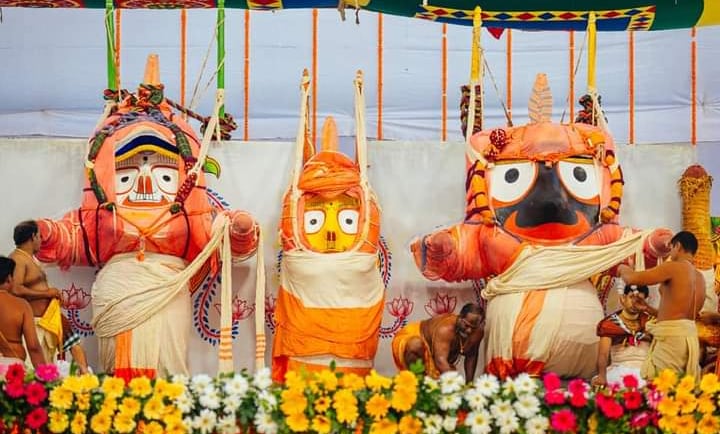
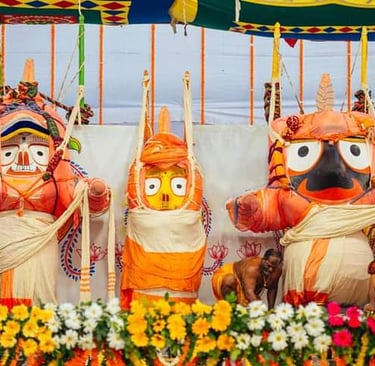
A national seminar held in a reputed institution of Orissa in recent past, had such a caption for one of its academic sessions. But excavating the creative dynamics of Orissan cultural identity, one aptly finds there are two serious misgivings, at the outset, to such a title. Firstly, to associate the term 'cult' with Jagannath Dharma' appears as preposterous as describing the Himalayas as an ant-hill. Secondly, Jagannath-Dharma is not a factor, the 'factor' of Oriya identity. An attempt is made in this paper to substantiate to these contentions. The continuing and fluid nature of some traditional notions and their complicated interplay with feelings of localism and nationalism as a matrix of crucial understanding would feed fat the contention that Jagannath Culture and Oriya - identity are but synonyms, mutually co-relative, the former is the emblematic expression of different kinds of Oriya identities relating to gender, class and nationhood. The explosion of academic and popular interest, in recent times, on the issue of social identity is normally marked by a neglect of the historical engagement between the 'regional' and the 'local' and the 'national'. Integration of many sources and techniques, as attempted herein, would do justice to the above contention regarding Orissan identity. That 'Jagannath Culture' and Oriya identity are corollaries may shake the sterile security of the sceptic's position; but as a statement, it is true and meaningful. A statement is true if things are as they are stated to be. As Aristotle said, "To say of what is that it is or of what is not that it is not is true." Identity in this context is a connotation of this spatiotemporal attributes. Examined from points of view of qualitative identity, synchronous identity and identity at any particular given time, the Oriya- identity merges into Jagannath Dharma. Spatio-temporal continuity is always a necessary condition for the identity of the material objects and how this condition is to be spelt out depends on the nature of the material object which is being judged.1 This latter part is specified by the introduction of the proper covering requirement ranging from continuity of form to identity of parts. Man's basic problem is moral in that being responsible is the requirement for mental health.2 The 'General Will' of Rousseau or the 'Categorical Imperative' of Kant were connected with religious injunctions such as justice and righteousness to roll down as a mighty stream. As Choudhury says, "In early days, religion was the cheap motivating factor for any voluntary service, but subsequently social and political consideration, too, influenced such action."3 The history of the Jagannath Temple liturgical rituals reveals the variety and splendour of Jagannath-dharma, the profundity of its theological thought as well as their deep impact on culture and society of Orissa. Its syncretism of all divergent forms of Indian metaphysical thought and spiritual faculties tend to transcend it to 'sanatana' proportions the cumulative result of fervent and indulgent dispensations of all segments of Indian spiritual tradition. It transcends 'dharma', and, as such, to call it a 'cult' would be symptomatic of pompous ignorance. Excavating further the creative dynamics of a rich tradition, one finds no iota of truth in any inherent factionalism, sectarism or caste-bias or narrow identity groups based on caste, ethnic or minority identities specifically when the identity- groups that uphold and represent the interest of any specific and so called, identitygroups are functioning or made to function exclusively. The purpose of such so called identity groups is seldom antithetical to regional on national identity and hardly smell of any lack of fidelity to collective interest. Further, Jagannath Dharma is soaked in 'Sanatana' humanism i.e. neither materialistic nor spiritualistic bur compatible with both. It neither dehumanizes nor sublimates its followers to a state of spirits. It is both preventive and curative in its pragmatic postulates in that where divinity it torn apart from humanity, a dangerous pretention or predisposition to dogmatism about divinity and religion becomes evident.4 As William James said, this situation is "Most likely to make angels weep. "Yet, if given to choose between theism of Jagannath and atheism, one has to take the former choice since it is this, rather than the latter, that leads one to meaningful social consequences, thereby making life worth living. Its self- consciousness and revealing reflections on successive stages of Orissa's own past as a subject, alone, shall enable Oriya historians today to understand why their field has come to be what it is. To be shy of such an obvious and absolute historical implication would reveal an uncritical and self-effacing subjective bias. The Jagannath culture has been a balancing act, always striking a balance between freedom and creativity on one hand and discipline and restraint on the other. The martial arts of Orissa originating from the 'Akhada' tradition of Puri for the defence of the pride and heritage of Orissa, the worldfamous Odissi dance and music coming out of the temple tradition, the open air theatre of discourses known as 'Mukta Mandap' are but a few illustrious examples of the former. While this freedom has been a personal necessity, the discipline has been a social compulsion. Examples galore of the first invocation of Jagannath in each and every auspicious ceremony in the family whether religious, social, personal or political - are found in plenty. This culture has always called for voluntary restraint of greed and conscious promotion of enthusiasm for work, whether temple architecture or arts and crafts. This dharma has been trurth's embodiment of life and has always given the Oriyas the power to refashion their nature as per contemporary, moral imperatives. A conception of cultural studies rooted in the Oriya's lived experience constitutes, thus, its cultural syntax. Its flexibility is characterized by innovations that are indigenous, not exogenous or alien. The elements of diversity in Orissan society on the basis of caste or ethnicity came to be functionally tackled by the institution of 'Chhatisaniyoga' - a complex classification of 'division of labour' for services in the temple by 36 categories of servitors represented by all castes in an egalitarian system of services in the temple, under the benign supervision of the first servitor, the king who had consecrated his empire to the Lord. For nearly a millennium till date, this system has generated a matrix of cordial intercaste relations. The perception of cultural pluralism and the levels of support for the same are ironed out by the services rendered by the monastery of each sect of India that had initially vied with others for exclusive of deification of Lord Jagannath for itself. Thus has emerged a homogeneity and the acceptance of an integrative ideology for Orissa. A study, alone, of their philosophies would not tend a scholar to exempt the 'Panchasakha' or the 'Mahima' savants from the realms of Jagannathdharma, for, Jagannath
Don't miss out on exclusive news related to Shree Jagannath Culture
Subscribe to our Newsletter
Postal Registration No.- PURI/45/2022-24
CBC Code No.- 320402
Copyright ©2023 . Shree Shrikhetra Soochana Newspaper, All Rights Reserved.
Rajesh Kumar Mohanty
(Editor & Publisher)
Shree Shrikshetra Soochana Newspaper
Raghunath Bhavan, Narendra Kona
Puri, 752001, Odisha, India
Contact
RNI Registration No.- ODIBIL/2021/81452