Jagannath Culture as Reflected in Gita Govinda
ARTICLE
Dr. B.L. Malla
3/31/20246 min read
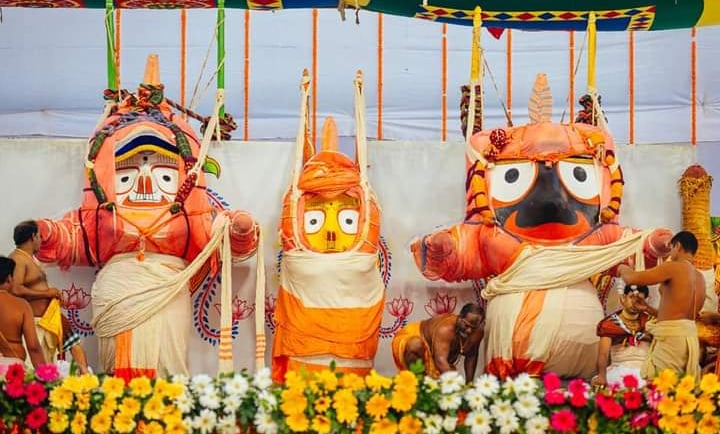
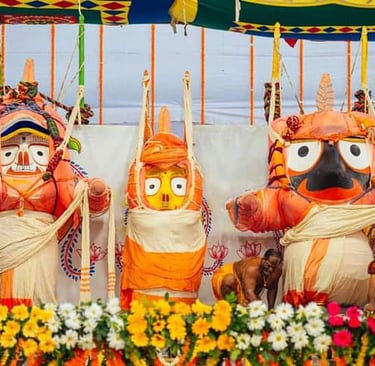
Sri Jayadeva was the famous composer of Shree Gita Govinda. His lucid composition of Gita Govinda became world famous during his life time especially because of its introduction in the rituals of Jagannath Culture. Its romantic as well as religious fervour ignited the devotional thought of priests, peasants and Royal personalities alike. The construction of Jagannath temple at Puri by Choda Ganga Deva in 12th Century A.D. ushered in a new era in the religious history of Orissa. With the decree of the Ganga emperors Gita Govinda was sung everyday in the temple as a result of which it became popular in every household in Orissa and India as well. Gita Govinda describes the love sports of Radha and Krishna in a beautiful manner. The charming and simple language of the text attracted one and all from every quarter. The depiction of Avatar conception in the composition of Jayadeva deserves special mention. Similarly, the description of Radha Madhav Cult which was in vogue in Prachi region is very interesting in the poetic articulation of Jayadeva. For the first time we find reference to Radha as a cult icon in his poetic creation. Vaishnavism received new impetus because of the impact of Jayadevas Gita Govinda from 12th Century A.D.
Many new ideas and ideation entered into the fold of Jagannath Consciousness after the emergence of great poet Jayadeva. His work also popularized Jagannath worship in every nook and corner of Orissa. It is glorious that the great poet Jayadeva was born in the sacred soil of Prachi Valley region. The popular Jagannath Cult is a mysterious religious system. Scholars from different parts of the country and abroad have attempted to solve the mystery of origin and evolution of Jagannath cult and have stumbled confusedly at the platform of religious eclecticism of Jagannatha Triad. Jagannath allows all and admits all, yet He is aloof from all. It is also said that He is all of it and none of it. He is like a mirror where all can see their reflection but cannot touch. He adorned his ratnasimhasan admitting flexibility, adaptability, integrity and magnanimity of all dynamics of Hinduism. For this, the Jains, Buddhas, Vaisnavas, Saivas, Saktas, the tribal aboriginals, prelates and potentates surrender at His feet seeking eternal salvation. The earlist reference to Jagannath-Daru worship is found in the Vedic literature. In the Mahabharata there is mention about a Vedi near the eastern Kalingan sea. Scholars have identified this spot with the present day Jagannath temple complex of Puri. Indrabhuti the king of Sambala in his famous work Gyanasiddhi speaks to Jagannath as Buddha in the 8th century A.D. Sankaracharya in course of his religious conquest of India in 8th/9th century A.D. visited Puri and worshipped Jagannath. The Anargharaghava Natakam of Murari Misra (9th century A.D.) refers to Purusottama. There is mention about a "devayatana" that existed at Puri in Prabodha Chandra-dayo Natakam of Krusna Misra (11th century A.D). The Saradadevi temple inscriptions of Mahihar in Satna district of Madhya Pradesh describes Purusottama as the Lord of Utkala in 10th century A.D. In the Baramdeo temple epigraph of 1088 A.D. and Nagpur inscription of 12th century A.D., there is reference to Purusottama Kshetra that existed in Orissa. In ancient Hindi literature like Bisaldev Raso (12th century A.D.), Prithvirayo Roso of the same century Jagannath is described as the deity of Orissa. Thus there is ample evidence of Jagannath at Puri since remote antiquity. The glory and greatness of Jagannath and Puridham find mention in the Puranas like Matsya, Brahma, Narada, Padma, Kapilasanhita, Niladrimahodaya and the Utkal Kanda of the Skanda Purana. In all such Puranas, He has been described as the famous deity of Odra or Utkala. In the tantric works like Kalika Purana, Rudrayamala tantra, Brahmayamala tantra and Tantrayamala, etc. of 10th century A.D. Jagannath is mentioned conspicuously. The foreign scholars like Stevens, Wilson and Fergusson etc have traced his origin in Buddhism. Rajendralal Mitra has opined that during pre- Christian century only Buddhism was in vogue in Orissa. Chinese traveller like Yuan Chwang has narrated that Mahayana Buddhism was the religion of Utkala in 7th century A.D.. This school of scholars believe that original Jagannath temple complex was a Buddhist establishment. Very recently a Chunar sand stone pillar has been traced out below the fossilized Garuda pillar of Natamandira while repairing it by ASI. This further strengthened the Buddhist origin of Jagannath. From the funeral pyre of Buddha at Kasinagar a tooth relic was known to have been brought by Therakhema to Puri of Orissa. For this for centuries Puri was called Dantapuri. It is believed that it is still there as Brahmadhata, in the wooden statue of Jagannath which is mysteriously shifted to the new idols at the time of Navakalevara. Alexandar Cunningham has stated that the three shapeless figures of Jagananth and His brother and sister are simple copies of the symbolical figures of the Buddhist triad i.e. Buddha, Dharma and Sangha of which the 2nd is always represented as a female. The Buddhist origin of the Jagannath figure is proved beyond all doubt by their adoption as the representative of the Brahmanical avatar of Buddha in the annual almanacs of Mathura and Benaras. Dr. H. K. Mahatab has also referred to a similar stone of Asokan polis with the symbol of Buddha, Sangha and Dhama discovered and sent to Calcutta University sometime back for preservation in Asutosh Museum. According to him the Savaras of Orissa were converted to Buddhism during the time of Asoka and worshipped the Triratna symbol in a Buddhist stupa at Puri. Later on in the 7th/8th century A.D., when Buddha was considered as an avatar of Vishnu, Jagannath was also considered to be an avatara of Vishnu. Gradually Buddhism lost itself in Vaisnavism. Another school of scholar like Nilakantha Das believed in Jaina association of Jagannath cult, so far its origin is concerend. He has tried to identify Nilamadhava with Kalinga Jina referred to in the Hathigumpha inscription of Kharavela which was known to have been taken by Nanda ruler as war trophy in 4th century B.C. The said Jaina symbol came to be known as Nila i.e. void or black. The image of Jagannath, that is why represents black colour or void. Subhadra is being identified with the Dharmachakra of Jainas and Kavalya so closely connected with Jagannath, has in fact Jaina origin. Kedar Mahapatra and Binayak Misra also subscribe to this school of thought. For this they have attempted to identify the legendary Indradyumna with emperor Kharavela who brought back the Kalinga Jina in 1st century B. C. which was taken away by Mahapadma Nanda in 4th century B.C. to Pataliputra. Jagannath is also adorned as Darudevata of Vedic and Bhagavatism. According to P.Mukherjee in about 5th century A.D. during the Gupta rule, Sankarsana and Vasudeva came to be worshipped as Balarama and Jagannath. The Brihat Samhita of Varahmihira of 6th century A.D. associated Ekanamsa with Subhadra. In Harivansa, She is described as the daughter of Nandaraja and also as the common sister of Jagannath and Balabhadra. Under the influence of the Bhagavatism, She came to be worshipped as Subhadra as their common Shakti being the sister, a phenomenon unknown to Indian tradition. Thus the cult of Shakti entered into the fold of Jagannath worship in a zigzag manner baffling the beholders and philosophers alike. Another strange aspect of the Cult is the Sabar connection in the origin and worship of Jagannath tradition. Jagannath Das in the Musaliparva of Mahabharata has written in the 15th century A.D. and said that after the Mahabharata war Pandavas left for heaven through Himalaya. The Yadava Vansa of Krisna got destroyed by Krishna Himself through the deluge of intoxication and homicide of the clan. The Krisna avatara lila of Dvapara Yuga was thus to be concluded. Lord Krisna, to leave the mundane world was swinging in the forest. A Savara, thinking Him to be a deer shoot an arrow at Krisna. When the Savara came to know of this he cried and prayed God to excuse him. Consoling him the Lord said that this incident was preordained to put an end to his avatar of Dvaparajuga. He further directed him to burn His body and to immerse the ashes in the ocean. The Savara could not completely burn His body. As per heavenly direction, he threw it in the ocean. It floated and in coarse of time came to the divine direction brought it to the palace to make the wooden statues of Balabhadra, Subhadra and Jagannath. A story goes that no carpenter could handle the wooden log. Ultimately an old carpenter came and assured the king that he can make the statues under one condition that he would not be disturbed for fourteen days and he would do his job inside the temple by locking the door. The king agreed to the terms and conditions. But hearing no sound of the carpenter from outside, the Queen insisted the king to break open the door before the completion of 14 days and to his surprise the king found the deities half made and the old carpenter vanished. He prayed God who advised him to worship Him in that form which we find today. Many such other stories in different versions are found about the Savara connection of the Jagannath culture. The Daitapatis now claim their origin to this Sabar tribe. Thus the synthetic and syncretic cult of Jagannath is the embodiment of several cults of diverse religious philosophies that existed in India in different periods of her long cultural history. In the historic process of assimilation, it has embraced strange contradictions and varied traditions of various religious orders and has emerged as a universal heritage of world eminence.
Don't miss out on exclusive news related to Shree Jagannath Culture
Subscribe to our Newsletter
Postal Registration No.- PURI/45/2022-24
CBC Code No.- 320402
Copyright ©2023 . Shree Shrikhetra Soochana Newspaper, All Rights Reserved.
Rajesh Kumar Mohanty
(Editor & Publisher)
Shree Shrikshetra Soochana Newspaper
Raghunath Bhavan, Narendra Kona
Puri, 752001, Odisha, India
Contact
RNI Registration No.- ODIBIL/2021/81452