Mahaprasad of Lord Jagannath
ARTICLE
Dr. Harihar Kanungo
1/2/20255 min read
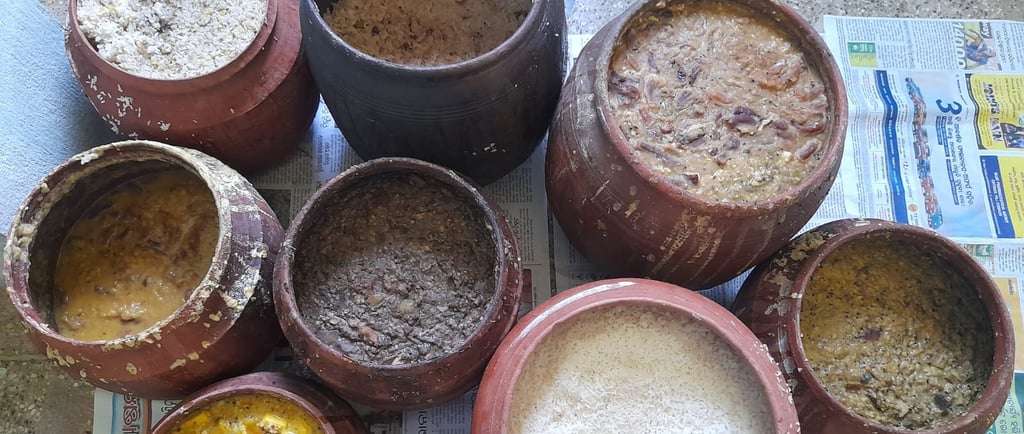
After Lord Jagannath was unearthed from Sonepur and transferred to Puri, He was installed in a patola of 38 yards. Certain rituals and rites were then observed in his worship and the partaking of Mahaprasad is one of them. Since the days of antiquity, the Sriksetra Puri Dham has gained prominence as a Holy place. The Mahaprasad (offering) of Lord Jagannath, the presiding deity is world famous. While the offerings for the deities in other temples in India are called prasad, those made for Jagannath are called Mahaprasad. Puri has the unique custom of discarding racism, casteism or the stigma of left over, when people share Mahaprasad together. Pandit Surjanarayan Dash, discussing about the speciality of Mahaprasad writes, "Among the four Holiest places of India like Rameswar, Jagannath, Badri and Dwaraka, the land of Lord Jagannath is the most sought after one. Its geographical location attracts many people. Jagannath's Mahaprasad is partaken en masse not withstanding caste and religion - and this secular attitude has popularised the Jagannath culture. The ritualistic Brahmins, Ksatriyas, Vaishyas and Sudras do not discriminate among themselves, while sharing Mahaprasad or even sharing its left over among one another. At the time Mahaparasad is consumed by large groups of people, caste distinction is thrown into the air albeit for a short time. At that moment caste difference is forgotten in creed, deed and word, people eat and feed this holy cooked rice and take away some rice from other's mouths and eat it themselves considering this act as a holy and sanctifying ritual. Such a practice arouses a feeling of unanimity and fraternity and establishes the oneness of Hinduism. Besides it also reiterates the liberal attitude of humanism.1 While partaking Mahaprasad from one another, the devotees do not scruple about caste, creed or religion nor do they mind about eating it from others mouths. It is very difficult but not impossible to discover precisely when and why this tradition of mass partaking of Mahaprasad became an integral part of Jagannath worship. Pandit Krupasindhu Misra opines that this tradition was Mahaprasad of Lord Jagannath Dr. Harihar Kanungo 54 Orissa Review June-July - 2007 set by king Jajati Keshari. From a legend mentioned in the book "Jagannatha Kaifiyata", glorifying Mahaprasad, it is known that Mahaprasad was introduced from the time of Jajati.2 Tantra worship had been propagated and established by the time king Jajati, the descendant of the Soma dynasty conquered Orissa. The Soma Vamshis themselves practised Saivaism. But prior to them, by virtue of the patronage from the Bhaumakaras, Saivism, Saktism and Tantrism became popular and gained the status of state religion. After Jajati installed Jagannath at Puri and made rules for his worship, he, out of respect for tantra, promulgated the Lord's worship as per tantrik methods. In the tantrik cult, Lord Jagannath is regarded as Bhairava and the Goddess Vimala as Bhairavi. "Utkala Navi Deshescha Bimala Purushottame / Bimala Bhairavi Yatra Jagannathastu Bhairava.//" So the Bhairavi Chakra has been drawn near the Ratna Simhasana or Vedi in the Jagannatha temple. Sri Jagannath is installed on this Srichakra. Image of Bhairava was also installed on the Ratna Simhasana. It is learnt from a report of James Hunter, dated 6.12.1806 that the image was removed from Ratna Simhasana afterwards.3 In deference to the Tantric Cult, Jajati installed Jagannath as a tantric deity in Puri. This tantric traditions developed as a part of Vajrayana from the Buddhist era. In the tantric tradition any thing offered to Lord Jagannath cannot be contaminated by caste or touch. Regarding this Prof. Prahallad Pradhan, quoting from "Hevajratantra" and "Guhyasiddhi" says, "The practice by devotees of taking food offered to the Panchen Lama has some similarity with the communal eating of food offered to Lord Jagannath by the devotees of the Hindu community, irrespective of caste. This writer thinks that it is the remnant of a Buddhist practice of the tantric period, still lingering in the Puri temple. Food in the Puri temple is not polluted by the touch of a person of any caste, even if it is left over after eating and thrown on the road. It is called Nirmalya or unsullied.4 The religious tradition of Orissa has accepted Jagannath as a tantric deity. This tantrism is manifested in his worship rituals and festivals. As per the Sakta faith, Prasad offered to Jagannath becomes Mahaprasad only after it is offered to Goddess Vimala. In deference for this tradition, king Jajati constructed a 38 cubic feet high temple for Sri Jagannath and at its Nairuta angle, thereafter constructed an 18 cubic feet high temple for Goddess Vimala. As per Jajati's arrangement, the offering made to Jagannath becomes Mahaprasad (the grand offering) only after it is offered to Vimala. It has been mentioned earlier that Lord Jagannath is installed on the Bhairavi Chakra. Because of offerings made to him are never contaminated by touch, Sir John Woodroff comments on this, "During the Chakra all eat, drink and worship together, there being no distinction of caste." Kularnava Tantra also states that after initiation to Bhairavi Chakra people of different castes shed this caste difference. But they again develop this difference if they refrain themselves from Bhairavi :- "Prabrutte Bhairavi Chakre Sarve Barnah Dwijatayah/ Nibrutte Bhairavi Chakre Sarve Barnah Pruthak Pruthak.//" Pandit Nilakantha Das says that the place where offerings are made to Jagannath is called Bhairavi Chakra. That is why Ratnavedi is called the Lord of Bhairavi Chakra or Tantrapitha. So 55 Orissa Review June-July - 2007 the tradition of sharing Mahaprasad found in Jagannath temple is based on the tantric tradition (Parampara) associated with the cult of Vajrayana. This cult of Buddhist tantra promulgated by Indrabhuti in the 8th century A.D. was transformed into Vajrayana in course of time. The cult of Vajrayana created tantric tradition in the land of Jagannath. In addition to this, the worship of Jagannath has also been greatly influenced by the Savari tantra as He is the deity of the Savara tribals. Jagannath's Mahaprasad is called "Abadha." In the tribal Saura language spoken by the Sabaras, Abadha means the act of boiling some thing in water.5 Mahaprasad is called so as the rice used in it is boiled in water - (Ab-ada = boiling in water). Therefore, by the advise of Sankaracharya the then king made arrangement for the offering of boiled rice before Jagannath. This arrangement seems to be influenced by the tribal Sabari culture. Following the Odda Sabara Culture offerings consisting of rice boiled in bamboo poles (Menjan bhinne) or Mayens (some eatable roasted in fire) are placed before the God. This boiled or roasted cookeries were described by Sarala Das, the Sudra Saint as Sauribidhi cooking. Such offerings were said to have been made to the God called Sabari Narayan worshipped before Nilamadhab by his wife Sriya, the Sabara girl at Sripura. The Sauras, the original priests of Sabari Narayan of Sripura point out that, their original God has left for Puri and after being installed there in Srimandir, is at present called Jagannath.6 Prior to installing Lord Jagannath at Puri, Jajati Keshari must have been aware of the firm tradition followed in worshipping the Lord. By that time, Lord Jagannath had been honoured and recognised as the state deity. So while reinitiating the Lord's worship he might not have thought it proper to violate that strong tradition. On the contrary adhering to that tradition might have helped in realising his political ambition. He promulgated the practice of mass sharing of Mahaprasad by the devotees, irrespective of caste or varna and such practice must have helped in fostering a sense of unity among his subjects. Thereby, he not only recognised a long followed rich tradition, he also must have attained a political mileage. Foot Notes : 1. Dash, Surya Narayan - Jagannath Mandir O' Jagannath Tatwa (Oriya), Friends Publishers, Binodbehari, Cuttack-2, 1982, p.1-2. 2. Mishra, Purna Chandra - Shree Jagannathanka Mahaprasad in Shreeksetra : Shree Jagannath (Oriya) pt.I(Ed) Utkal Pathak Samsad, Orissa Book Store, Cuttack-2, 1986, p.218. 3. Jagannath Temple correspondences for the year 1804 to 1932, Vol.I, Board of Revenue, Orissa, Cuttack, pp.72-73, 133-135. 4. Pradhan, Prahallad - Presidential Address at the 2nd General Conference of International Association of Buddhist Studies at Nalanda, 1980 in Anama-19 (Oriya journal) May, 1983 (Ed) Gokal Behari Mohanty, Neela deep, Idga Chhack, Cuttack-8, pp.11-12. 5. Mishra, Haraprasad - Shree Jagannathanka Gundicha Yatra Rahasya (Oriya) in Jhankar, 37th year, 11th issue, February, 1986, p.999. 6. Anama-19 (Oriya Journal), May 1983, (Ed) Gokul Behari Mohanty, Cuttack-8, p.17-18.
Don't miss out on exclusive news related to Shree Jagannath Culture
Subscribe to our Newsletter
Postal Registration No.- PURI/45/2022-24
CBC Code No.- 320402
Copyright ©2023 . Shree Shrikhetra Soochana Newspaper, All Rights Reserved.
Rajesh Kumar Mohanty
(Editor & Publisher)
Shree Shrikshetra Soochana Newspaper
Raghunath Bhavan, Narendra Kona
Puri, 752001, Odisha, India
Contact
RNI Registration No.- ODIBIL/2021/81452