
Narendra Tank in Legend and History
ARTICLE
Santosh Kumar Rath
9/13/20235 min read

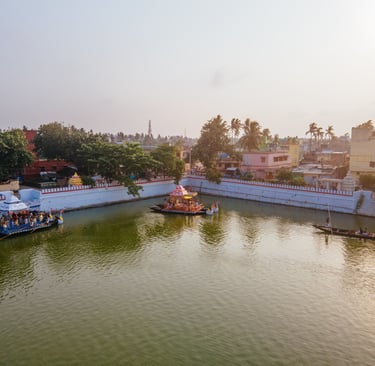
According to one legend during the reign of Gajapati Kapilendra Dev, Veer Narendra Dev, his younger brother sacrificed his life for the sake of his motherland. His wife Kalandi Mahadevi after the death of her husband renounced all worldly pleasure and resided in a garden inbetween Jagannath Ballabha and Balabhadra Ballabha garden. She worshipped Lord Siva and Krishna in that place. Babaji Govinda Das was her guru. Once the guru offered a pumpkin seed to the queen. The queen planted the seed. The vegitative growth of the pumpkin creeper was so luxuriant that it spread in an area of 1350." Hundreds of pumpkin were produced from it. Those pumpkins were utilised for preparation of Mahaprasada in the temple. It was a talk of the town at that time. The fame of Kalandi Devi and the miraculous pumpkin plant reached the ear of Gajapati Kapilendra Dev. The fourteen sons of queen Kalandi Devi came to her mother who was staying alone. One day Gajapati Kapilendra Dev accompanied by his guru Mahadev Brahma paid a visit to the residential garden of the queen Kalandi Mahadevi. At that time Govinda Das, the guru of Kalandi Devi was engaged in the worship of Lord Gopinath. Guru Govind Das blessed the king who was eager to meet queen Kalandi Devi. Guru Govind Das requested the king to excavate a famous tank for her, after the name of her late husband Veer Narendra Dev. To fulfil the desire of the queen he also requested the king to name the main ghata after Narendra Dev, the next one in the name of queen Kalandi Devi. The king also constructed fourteen ghatas after the name of fourteen sons of Narendra Dev. Chandana bije ghata (Lamba Chakada) was constructed for 14 Orissa Review June - 2004 the purpose of 'Chandana bije' of Lord Jagannath. This Chakada is named after Narendra Dev. Apart to all this the king Kapilendra Dev constructed a temple for Kalandisvara Shiva and Gopinath on the bank of this holy tank. The Brahma Jaga after the name of Narahari Brahma (court poet) also established. Thus the famous 'Chandan Yatra' of Lord Jagannath is being observed in pomp and ceremony in the holy Narendra tank from those days.1 From the old administrative records of Srimandir it is known that the creation of Narendra tank is due to the seed of pumpkin. The story is as follows: "During the reign of King Narendra Dev of the vassal state Ranpur had very good relationship with the Gajapati king of Puri, King Narendra Dev was a great devotee of Lord Jagannath. Once he got a pumpkin seed while moving leasurely in the countryard of his palace. The king in his jolly mood gave the seed to a Sarbarakara (Revenue Collector). He told the Sarbarakara to plant the seed in the name of Lord Jagannath and to offer all the pumpkins produced to the Lord. The Sarbarakara planted the seed in the name of Lord Jagannath with full devotion. Astonishingly the growth of the pumpkin creeper was luxurant and covered an area of 14 acres. This creeper had a life of 5 years. Lakhs of pumpkins were produced. The sarbarakara sold all the pumpkins worth lakhs of rupees. The Sarbarakara deposited all the money to the king Narendra Dev. King Narendra Dev offered the money to Gajapati King of Puri. Both the kings decided to construct a tank at Srikshetra out of this fund. The tank was of the area of 14 acres same to the area the creeper covered.2 This is the tank of present famous Narendra. Narendra is the biggest and historical tank of Srikshetra. From historical point of view it was established in 14th-15th c.A.D. Madala Panji mentions about Narendra tank, that 'Lakhaposa Narendra Mohapatra', the minister of Ganga King Veer Narasingha Dev excavated the 'Narendra Saucha' tank.3 From the very word 'Narendra Saucha' it is known that this tank was built for the purpose of daily use. It is clear from the above description that this tank was built during Ganga period. 'Chara Ganesha' is worshipped in a nearby Jaga close to this tank. Tradition says that the scaffolding was done to carry big stone slabs for the construction of the great temple from here. From another account it is known that the brother of Gajapati Kailendra Deva had dug this tank. So this tank was created in the middle of 15th c.A.D. (Suryavamsi Period). Narendra tank is situated at Mauza Dandimala Sahi. This tank stands on the revenue plot No.117 and 199 respectively. The tank covers an area of 14.533 acres. The water level of the tank is about 10 feet below the present road level. There are 16 ghatas of the tank. Among these ghatas 14 are named after the 14 sons of Narendra Deva, one after his queen Kalandi Devi Kalandiswar ghata and the main ghata i.e. Narendra Chakada ghata after Narendra Deva, brother of Gajapati Kapilendra Dev. 4 There are 3 ghatas in the east, 4 in the west, 3 in the north and 6 in the south (including the chief ghata) respectively. The main ghata contains a flight of steps made of Khondalite stone. The approximate depth of the tank is 28." The size of the tank is nearly square measuring 834" by 873."5 The tank has an island in its centre bearing a small temple of later period called Chandana mandapa (50" x 12") connected with the south bank with a bridge to 15 Orissa Review June - 2004 which Madanamohana, the moving deity of Lord Jagannath, is brought for 21 days during Chandan Yatra. The tank was previously a fine sheet of water which was kept clean by flushings from the Madhupur river (Mitiani river) during the rains through a channel in the western corner. 6 Over this Madhupur river stands the famous Atharanala Bridge. It is the entrace of Puri town. Presently both the inlet and the outlet of the tank are completely choked up and the system no longer works. The water as a result has turned filthy. On the bank of Narendra, Chara Ganesh, Gopinath Ballabha Matha, Brahma Jaga and Jatia Baba Matha are situated. The historical study of the tank would be incomplete without the study of Chara Ganesha and Brahma Jaga.
The most celebrated, picturesque and one of the large tanks of Odisha perhaps is the Narendra Tank. Because of its close relationship with Jagannath Temple it is considered a holy tank among the pious Hindus. According to one legend 'Narendra Deva' brother of Gajapati Kapilendra Deva excavated this tank and it was named after him. This holy tank is also known as 'Chandana Puskarini' because the famous 'Chandana Yatra' of Lord Jagannath is celebrated annually in this tank. Many medieval Oriya texts described the fame of this holy tank. This largest tank of Puri is 1 km. far from Jagannath Temple. It is situated on the left side of the Grand Road running from Jagannath Temple to Gundicha Temple. A good approach road is running from Grand Road through 'Dandimala Sahi' to this tank. The surrounding area of this tank gives a picturesque appearance to this place. On the east of the tank there is Grand Road, Markandeswar Sahi and Temple of Bisoi Thakurani on the west, Brahmagiri Road and Jatia Baba Math on the North and Jagannath Ballabh Math on the south.
Don't miss out on exclusive news related to Shree Jagannath Culture
Subscribe to our Newsletter
Postal Registration No.- PURI/45/2022-24
CBC Code No.- 320402
Copyright ©2023 . Shree Shrikhetra Soochana Newspaper, All Rights Reserved.
Rajesh Kumar Mohanty
(Editor & Publisher)
Shree Shrikshetra Soochana Newspaper
Raghunath Bhavan, Narendra Kona
Puri, 752001, Odisha, India
Contact


RNI Registration No.- ODIBIL/2021/81452