Worship of Durga Madhab in the Grand Temple of Puri
ARTICLE
Durgamadhab Dash
10/7/20226 min read
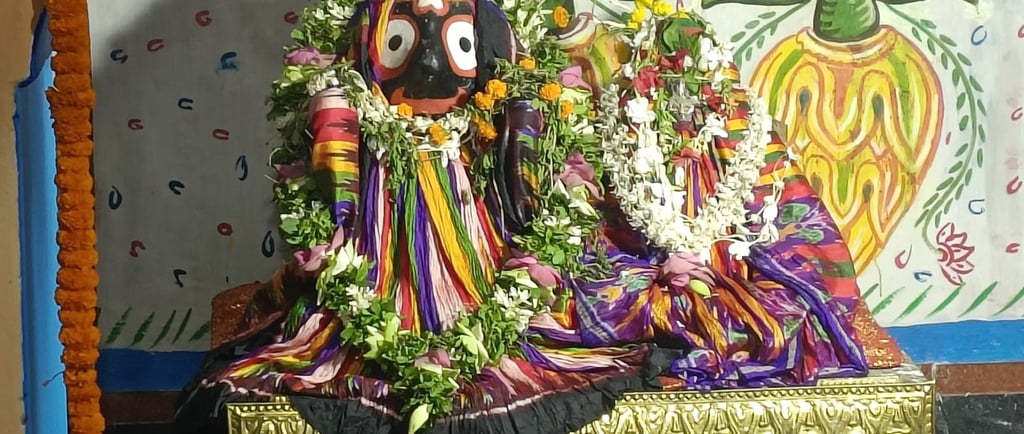
God is one. But He is adored and worshipped in different names and forms. The believers of God hold the view that the different forms of God whom people worship are but the symbolic expressions of different manifestations of the divine energy. By His very divine nature. God is present everywhere. He knows everything. He is aware of the past. He knows the future. He is allpowerful. So He is known as the omnipresent, omnipotent and omniscient Lord of the universe. God is also adored as Parabramba. He is the supreme power of the universe. Within Him is present the mystic power known as Maya- Shakti, the power of delusion. It is this divine force of the Lord that is ever vibrant. It is always agile in nature. This Shakti, in communion with God is the cause of all cre- ations and all destructions in the universe. It is said that the spirit of delusion makes God ever-expressive, flexible and peripatetic in every sphere of activity, both divine and undivine in nature. The Maya Shakti is explained in the scriptures as the Devi Shakti of the Supreme Brahma. Worship of this Devi Shakti along with God is divinely portrayed as Durgamadhaba Worship as prevalent in Srikshetra, Puri. In this divine practice, one worships both the Brahma and His Maya Shakti together. Gods Maya Shakti is also described as the Adya-Shakti of the universe. In some places. She is worshipped in the name of Jwalamukhi. In other places. She is worshipped in the name of Kanyakumari. She is also worshipped at some places as Bimala and somewhere as Durga, Bhairabi. Mangala and so on. All these divine forms are the expres sions of one and the same Mayashakti of the Almighty Lord. For the sake of a uniform expression, this divine prowess is eulogized as the Adya Shakti of the divine cre- ation. In Srikshetra Puri, the four armed Durga is wor- shipped as Bimala Thakurani. She is also adored and wor- shipped as Bhairabi. Lord Jagannath, the presiding deity of the Temple is known as Madhaba. He is adored as the moving idol of Lord Jagannath. Sri Jagannath, is also di- vinely worshipped as Bhairaba. The worship of Bhairabi and Bhairaba is observed in the Grand Temple. It is run through a periodic divine ritual. It is an illustrious divine practice. It is observed in the Grand Temple in pomp and ceremony in the month of Ashwin. Scriptures say that worship of Durgamadhaba is as old as the inception of the Grand Temple. There is a beautiful story to substantiate this spiritual truth. The story runs as follows. As we all know, it was during the time of Maharaja Indradyumna that the Grand Temple of Lord Jagannath was built in all its grandeur. According to a spiritual expo- sition, after the Grand Temple was built. Maharaja Indradyumna went to Brahmadeb to invite Him to earth for consecration of the Temple. At that time, Brahmadev was engrossed in deep meditation. As such, Maharaja Indradyumna had to wait at Brahmalok till the completion of Brahma smeditation. In the matter of calculation, one day in Brahmalok is equal to several thousand years on earth. In that way, when the Lord??s meditation was over for the day, several years had elapsed on earth. During the said period, the Temple, built by Maharaja Indradyumna had been covered with sand and slipped deep in to earth. As time passed by, a king known as Galamadhab had come to power on earth. He was a very powerful king. While he was moving along the region where the temple had been built, the hoof of his horse struck the pinnacle of the Temple. King Galamadhab immediately got down and ordered for excavation of the holy structure and at last, the temple of the Lord was discovered. He also discovered installation of goddess Bimala whom he worshipped for divine benediction in Tantric procedure. While so, Maharaja Indradyumna with Lord Brahma appeared at the temple site on earth and stated that it was he who had built the temple, and accordingly he established his right over the shrine and claimed the same from the imperial control of king Galamadhaba. The occurrence that next followed was a sort altercation between the two kings. At last, with the interven- tion of Lord Brahma, there was an amicable settlement of the matter between the two kings.It was in the presence of Lord Brahma that the difference was amicably, settled and it was decided following the amicable settlement that in Srikshetra Puri, there shall be in vogue a religious practice according to which, Maa Durga i.e Bimala who was the goddess of Galamadhab and Sri Madhab, ie Lord Jagannath who was the god of Maharaja Indradyumna, shall both be worshipped as a divine ritual in the Grand Temple. This spiritual happening, is widely believed in Srikshetra Puri as the background of the beginning of Durgamadhab worship in the Grand Temple. Thusthis practice has been in vogue since the incep tion of the temple. There is another popular belief that after dissipation of the religious differences between the Shaktas and the Vaishnavites, the sacred practice of Durgamadhab worship had first begun in Srikhetra Puri. The Grand Temple was the illustrious reli- gious alter from where this inviolable Vaishnavite cum Sakta religious systemization had sprung up bringing to the reli- gious front a re-designed mode of worship and this had come upleading to a new religious culture in Odisha which was ac- cepted by both the Vaishnavites and the Saktas in the ultimate run of events. On the northern side of the Bhog Mandap in the Grand Temple, two idols, the idols of Sri Madhab and Maa Bhairabi, have been nicely carved on a piece of stone bearing testimony to the fact that at one point of time in the past, both Sri Madhab and Maa Bhairabi were being wor- shipped together in the Grand Temple and that was actually the beginning of Durgamadhab worship which has now become very popular as a religious ritual in Odisha. There is another proof of this religious practice. This has reference to the Durgamadhab temple. On the south western corner of the Baharbedha of Srimandir, there is a temple known as Durgamadhab temple which substantiates the fact that Durgamadhab worship was very much in vogue among the inhabitants of Puri in the good old days. We have yet another specimen of historical corroboration on this score. The fact is that, when king Galamadhaba took possession of the Temple during Maharaja Indradyumna?s trip to Brahmalok to invite Brahma for consecration of the Temple, he had developed a chunk of land in the Temple area at Puri to provide accommodation to the Sebayats belonging to the Tantric mode of worship. Galamadhaba was a staunch follower of the Shakti cult. Maa Bimala, the principal god- dess of the Grand Temple, was his most loved divine spirit. The king had provided living accommodation to the Sebayats of the goddess at that place now known as Harachandi Sahi which presently extends from Manikarnika to Jambeswar Temple. Thus the inception of Harachandi Sahi is as old as the inception of the Grand Temple in Srikshetra Puri. Neces- sarily the Sabayats provided with living accommodation here were the Shaktas in their religious faith. When Indradyumna appeared on the scene with Lord Brahma for consecration of the Temple, he had with him his own group of Sebayats and they were Vaishnavites in their religious profession. The Sebayats of the Indradyumna-group had also been provided with housing accommodation at the above place following his compromise with Galamadhaba. Thus seen, at a particu lar point of time when the composite mode of worship had come into practice. Durgamadhab worship had been intro- duced in the Temple and both the groups of Sebayats had been provided with housing accommodation at the said place.Combining the elements Shakti cult and Vaishnavism. the concept of God as worshipped in the Grand Temple was better understood through one culture ie Jagannath culture. Be it stated here that a small portion of this street is still known as Galamadhaba Peetha. Even today, it bears an important reference in all postal communications. Briefly stated, this is the history of the beginning of Durgamadhab worship in Srikshetra Puri. This is said to be the most illustrious reli- gious practice of Utkal Pradesh. This is not in vogue in other Temples of our country. The practice of Durgamadhab wor- ship has become so popular in Odisha that in all social func- tions of an Odiahousehold, the ??Pattachitra?? of Durgamadhaba is first established on the religious alter and their worship is next done before the formalities of the social ritual are actually begun.
It is further believed that on the day of Dussehra, a full view of Durga and Madhab is considered most auspicious, as the scriptures say, this gives the devotee all prosperity and victory in life. It fulfills the desires of the devotee and pur- veys overall happiness in life. This is the worth and excel- lence of Durgamadhab worship as observed in all auspicious functions in Odisha. As regards the procedure being followed in Durgamadhab worship, it is said that Maa Bimala, the pre- siding goddess of Sri Mandir, Puri, is adored as the Adishakti of the universe. The consecration of Bimala Thakurani as the principal goddess of the Grand Temple has a puranic story.
Don't miss out on exclusive news related to Shree Jagannath Culture
Subscribe to our Newsletter
Postal Registration No.- PURI/45/2022-24
CBC Code No.- 320402
Copyright ©2023 . Shree Shrikhetra Soochana Newspaper, All Rights Reserved.
Rajesh Kumar Mohanty
(Editor & Publisher)
Shree Shrikshetra Soochana Newspaper
Raghunath Bhavan, Narendra Kona
Puri, 752001, Odisha, India
Contact


RNI Registration No.- ODIBIL/2021/81452